Empowering New Mothers with a Smarter Support System
Bloom

Project
Empowering new mothers
with a smarter support system
Timeline
2 semesters (continuing project)
Team
5 members
Collaborations
My Role
Researcher & Product Designer
Overview
Postpartum care has a gap, and it's not the kind you can fix with a single product.
This project began in HCI as a wearable solution for postpartum physical recovery, then evolved through a Health & AI course into a full support ecosystem. What started as a smart breastfeeding t-shirt became a question about what postpartum care actually looks like, and who it was leaving behind.
My Focus: Designing intelligent, low-effort support that meets mothers where they are emotionally, not just physically. make overview stronger, add collaborations as well
UX Researchers, Product Designers,
Visual Designers, PepsiCo. Stakeholders.
TL;DR
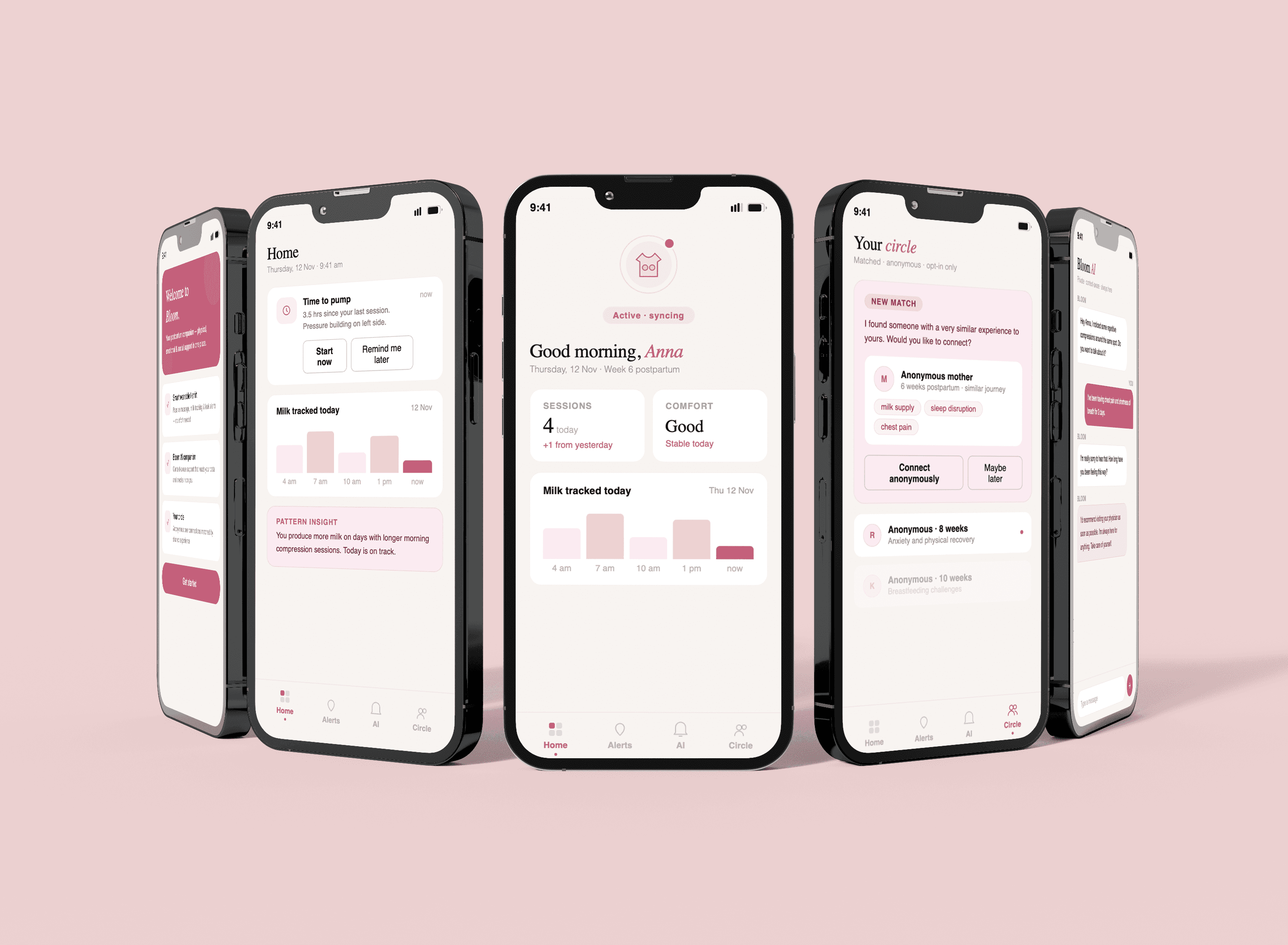
Watch the experience

A prototype walkthrough showcasing how the wearable,
AI companion, and community layer work together.
From milk tracking and smart nudges to empathetic
check-ins and anonymous peer matching
AI & Health
Wearable Design
UX Research
We designed a holistic postpartum support
ecosystem,a smart wearable t-shirt paired with
an AI companion and community matchmaking
layer, that addresses the physical, emotional, and
social gaps new mothers navigate alone.
The work reframed postpartum care from a
product into a system built around real
behavioral needs: passive support, just-in-time
information, and connection without pressure.
Project Evolution
Smart wearable t-shirt for
physical postpartum recovery
Intro to HCI · Semester 1
Health & AI · Semester 2
Full ecosystem: wearable +
AI companion +
community layer
Research
Co-design revealed emotional
& social needs were unmet
70%
of new mothers face
postnatal anxiety
1 in 3
face breastfeeding discomfort,
leakage & production anxiety
85%
report breast tenderness and
cramps postpartum
The Bigger Picture
The gap wasn't one missing product. It was a missing system.
The Opportunity
Postpartum recovery is treated as a physical process. Existing products address specific symptoms
like breast pain, milk leakage, cramps in isolation, leaving mothers to stitch together fragmented tools
while managing exhaustion, anxiety, and isolation.
Every need requires a separate
product. The burden of managing
multiple systems compounds stress.
Disjointed tools
Mothers felt emotionally adrift
but couldn't access judgment-free,
real-time support.
Isolation without diagnosis

Mothers have no bandwidth for
complex tools. "I don't have time to
fiddle with complicated settings."
Time collapse

Behavioral patterns found
We conducted 20+ digital ethnography studies, reviewed 10+ existing tools, and ran 8 primary
interviews. Co-design sessions with new mothers became the most important turning point.
Research - Understanding What Mothers Actually Need
Mothers wanted connection, but not
the noise of existing forums. Too
performative, too much comparison
Community with conditions

Participants consistently deprioritized
features that felt like "features." They
wanted clarity, control, and support
Practical over performative
Key Patterns
Physical and emotional pain are deeply interconnected, treating one without the other doesn't work
Time is the biggest design constraint at every level
Isolation is common but rarely surfaced in the tools built for this group
Existing communities create pressure, not relief
Safety concerns (radiation, heat near chest) were consistent and serious
What mothers said
"If it could tell me when my milk
supply is dropping, that would
be a game changer."
"I love the idea, but it
has to be something I can just
put on and forget about."
"I'd be worried about heat near my
chest. It has to be completely
safe while breastfeeding."
From problem to ecosystem
User Journey
The mother moves through four moments, each one enabled by the layer before it.




Wear
Track
Understand
Connect
Put the t-shirt on.
Nothing else needed.
Data flows in.
No input required.
AI interprets,
checks in, reassures.
Matched peers,
no pressure.
Rather than solving one touchpoint, we designed connected layers that support mothers across
physical recovery, emotional wellbeing, and social connection. Research revealed that friction
appeared at every stage, body, mind, and community.
The Four Layers
Each layer has a distinct role. Together they form a system where no part could work without the others.

01 · PHYSICAL RECOVERY
Smart wearable t-shirt
Passive support that works without asking
anything of the mother. Worn throughout the
day, it silently collects data, delivers haptic
massage, monitors milk production, and
alerts for leakage, all without requiring her to
do anything extra.
Haptic massage
Milk sensor
Leak detection
BLE · low radiation
Wearable support that works passively.
No effort, no decisions, no extra cognitive load.
02 · INTELLIGENT TRACKING
Tracking & insights app
Raw data becomes meaning. The app
translates wearable output into patterns a
tired mother can act on no interpretation
required. Instead of showing numbers, it
shows context: "You felt better on days with
longer compression sessions."
Milk tracking
Pattern recognition
Progress calendar
Daily summaries
Data made simple and actionable, translates
what the wearable collects into something a
mother can understand and use.

03 · EMOTIONAL SUPPORT
Bloom AI companion
Proactive nudges
Symptom check-ins
Safe escalation
Emotional validation
AI that interprets, reassures, and knows when to
step back, bridges data and human connection.
An emotionally-aware assistant that
reads wearable and app data to proactively
check in. It notices patterns before the mother
does, a gentle nudge, a question, a moment
of validation. It knows when to step back and
when to escalate to a professional.

04 · COMMUNITY
Your circle
Human connection without pressure or
noise. The AI matches mothers with peers
who share similar experiences, not a social
feed, but intentional 1:1 or small-group
contact that makes mothers feel seen and less
alone, entirely on their own terms.
AI matching
Anonymous 1:1
Small groups
Fully opt-in
Human connection without pressure or noise, the
layer that contextualises everything the system
has built.

How It Flows
WEARABLE
Generates data
Passive collection
throughout the day
APP
Visualises patterns
Turns numbers into
insight
AI
Interprets meaning
Proactive,
emotionally-aware
COMMUNITY
Contextualises it all
Human layer, always
opt-in

This is not a product with features. It is a system built around the mother, where every layer makes the
others more effective.
V2 FINAL
Stripped to essentials:
massage, milk sensing,
and leak protection
V1 REMOVED
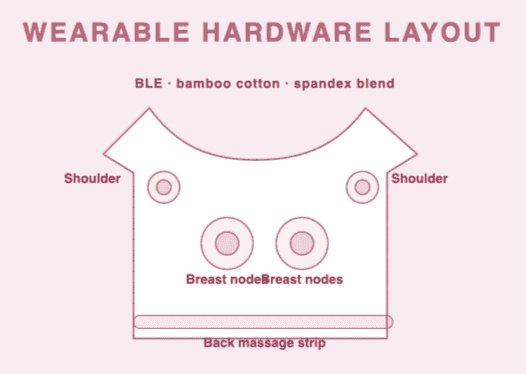
Bamboo cotton and spandex blend breathable,
moisture-wicking, adapts to postpartum body changes
Haptic massage nodes at shoulder, back, and breast.
Vibration triggered by touch or app presets
Milk production sensorspressure-based, alerts when it
is time to pump via vibration and notification
Detachable absorbent pads for leak protection,
removable for washing
KEY DESIGN DECISION
Using BLE keeps radiation output significantly
below household device levels. A direct response
to safety concerns raised in co-design. Every
technical choice traces back to something a mother
said.
FINAL DESIGN
Heating, LED therapy,
hug simulation added
complexity without
serving the core need
"Massages are great, but it's not a USP for me.
I want a simpler way to track my milk."
Co-design participant, new mother
Concept Deep Dives
PHYSICAL LAYER · 01
Mothers needed physical relief that didn't require them to do anything extra. The t-shirt had to be passive,
safe, and something they could put on and forget
Smart breastfeeding t-shirt
TRACKING LAYER · 02
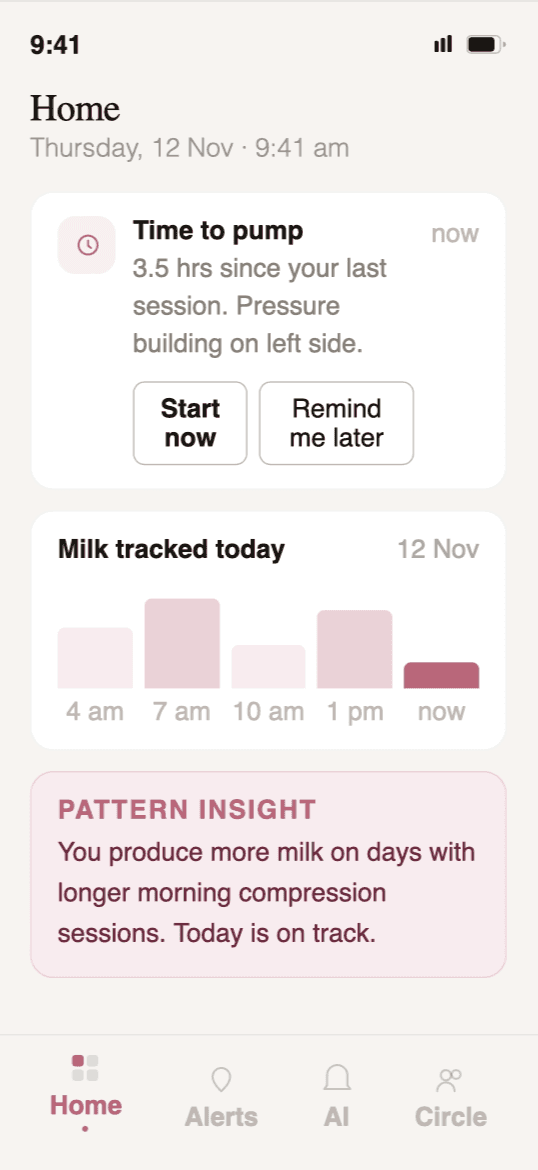
Raw data creates anxiety. The insight is in the pattern. The app translates what the wearable
collects into something a tired mother can actually use.
Milk and cycle tracking interface
FINAL DESIGN
KEY DESIGN DECISION
We stripped the app to essential metrics after
co-design revealed too many data points felt
overwhelming. One participant said her Apple
Watch tracking made her depressed. Less data,
more meaning.
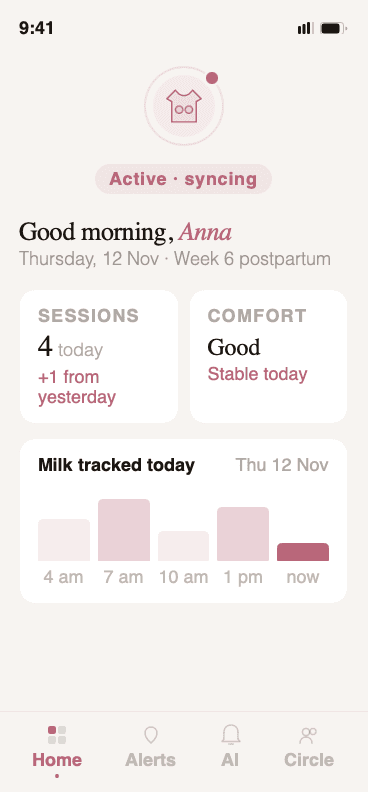
Session chart shows milk pumped over time
visually, not numerically
T-shirt status indicator active or inactive at a
glance
Pump reminders contextual and timed from
wearable data, not intrusive
AI pattern insights plain language observations,
never raw metrics
V1 REMOVED
Comprehensive
dashboard with
heart rate, sleep,
hormones, and
hydration
V2 FINAL
Single focus milk
tracking with optional
calendar. Clarity over
coverage
INTELLIGENT LAYER · 03
Mothers don't have time to search, compare, or validate information. They need someone who already
knows their context and knows when to step back
Bloom AI companion
Trust and transparency
Empathy over efficiency
Voluntary participation
Privacy and data control
VALUES INTEGRATED
KEY DESIGN DECISION
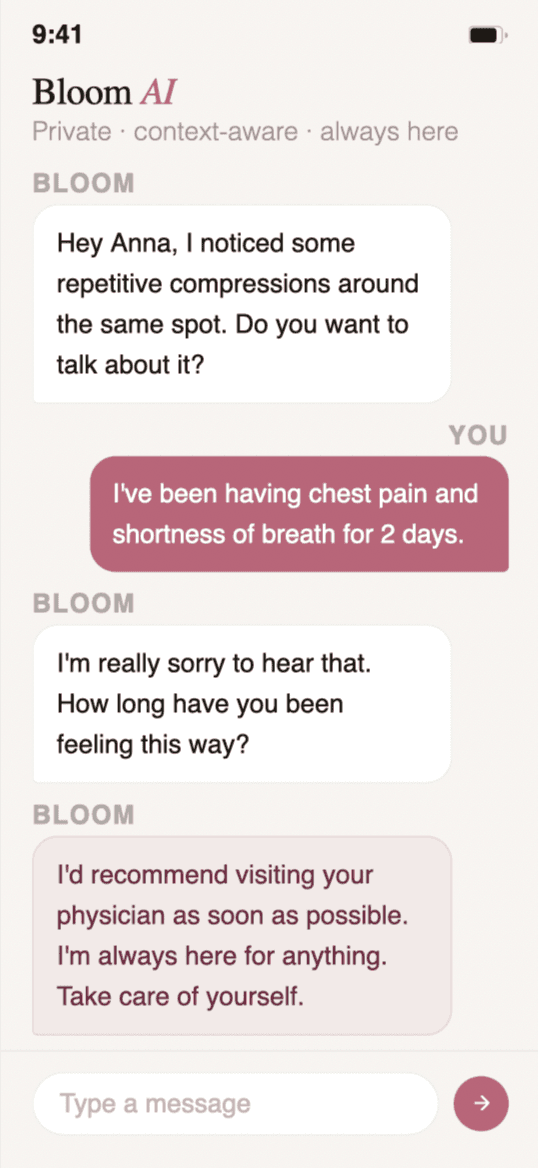
Safe boundaries are not limitations. They are the
product. The AI's willingness to say "please see
your physician" is what makes it trustworthy enough
to use.
KEY DESIGN TENSION
The AI needed to feel supportive without creating
dependency. It does not pull mothers deeper into
the app. It actively points them toward real-world
support. Helpfulness and restraint had to coexist.
Proactive check-ins reads wearable and app
data to notice patterns before the mother does
Conversational symptom exploration gentle,
context-first, never diagnostic
Reassurance within safe limitsvalidates feelings
without overpromising
Clear escalation directs to a physician when
symptoms need professional attention
Community surfacing suggests peer connection
when emotional need is detected
WHAT THE AI DOES
COMMUNITY LAYER · 04
Existing communities create pressure. Mothers wanted connection without performance.
Intentional, low-pressure contact matched by shared experience, not broadcast.
AI-based matchmaking
Personalisation
Growth
Belonging
Community connection
VALUES INTEGRATED
Empathy
KEY DESIGN DECISION
AI acts as a connector, not a supervisor. It
matches on patterns, never exposes data. Users
choose what to share at onboarding and can
delete everything at any time.
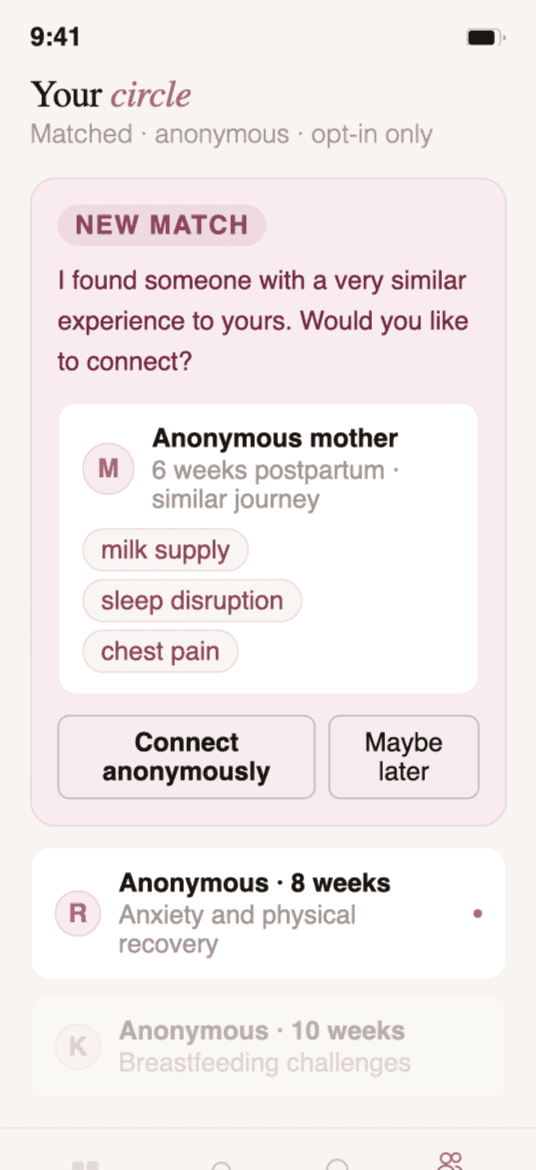
AI detects shared experiences not just
symptoms but emotional patterns too
Similarity-based suggestions not a feed,
not performative, not broadcast
Fully opt-in, anonymous, snooze-able the
mother controls everything
Formats 1:1 anonymous chat, small groups
of 3 to 5, passive "others feel this too" signals
WHAT IT DOES
1) Mother logs high stress. Wearable and app data flags
emotional need
2) AI suggests: "I found someone experiencing something
similar. Want to talk?"
3) Mother opts in or defers with one tap. No pressure, no
follow up
4) Anonymous connection opens. On her terms
CONNECTION FLOW
We know we've created impact when:
Before: Fragmented support, high mental load, isolation, multiple tools to manage
After: Integrated care system, reduced cognitive overhead, reassurance in real time, meaningful
connection
Impact
Reduction in reported
physical discomfor
Changes in stress or
anxiety levels
Wearable engagement
rate
Improved sleep
Quality
User satisfaction and
trust
What I Learned
Engagement is built through momentum, not moments
Sustained interaction emerges from small, reinforcing cues across the journey. Progress visibility
proved more powerful than added incentives in motivating action.
Research changes the problem, not just the solution
We started designing a wearable. Co-design revealed that the physical product was only one
layer of a much larger unmet need. The willingness to follow that insight transformed the project
AI earns its role through boundaries
The most important design decisions about the AI weren't what it could do, they were what it
wouldn't do. Knowing when to stop, defer, and redirect is what makes an AI feel safe rather than
surveillance-like.
Systems require honest framing
Calling the AI and community features "features" would have made the project feel padded.
Framing them as a response to unmet emotional and social needs discovered through research
made the whole thing coherent