SignalSense


Project
Supporting Early Identification of Student
Mental Health Distress in Schools
Timeline
16 weeks
Collaborations
My Role
Researcher & Product Designer
School counselors often encounter early signs of student distress, but these signals are scattered across disconnected systems and moments in time, making patterns difficult to recognize early.
SignalSense explores how interaction design can help counselors connect fragmented behavioral signals into clearer longitudinal insights.
My Focus: designing a system that helps counselors connect fragmented observations across time, making behavioral patterns easier to recognize while supporting existing workflows and reducing cognitive load.
Overview
Collaborators
Domain Experts including School Counselors,
Crisis Specialists, & Professional Counselor
Trainers
Methods
User Research, Systems Thinking, Interaction Design, UX Strategy, Prototyping
TL;DR

Mental Health
UX Research
A prototype walkthrough showcasing how the
capture tool, synthesis timeline, and escalation
queue work together.
System Design
SignalSense helps school
counselors identify emerging
behavioral concerns by connecting
fragmented student observations
across time.
Instead of relying on isolated notes
or memory, the system brings
together attendance changes,
classroom observations, counseling
records, and recurring behavioral
signals into one longitudinal timeline,
making patterns easier to recognize
before concerns escalate.
Research-Driven Design
The gap wasn't one missing product. It was a missing system.
The Problem
The information was already there.
The problem was that nobody could see it together.
Behavioral signals rarely appear all at once.They emerge gradually through attendance changes,
teacher observations, counseling conversations, and subtle shifts in student behavior. Yet these
observations are often documented in different places,making it difficult to understand how they
relate over time.Counselors weren’t missing information.They were missing visibility across it.

How are observations captured
and revisited?
Documentation
Interpretation
Where does sensemaking
break down?
Pattern Recognition
How do counselors identify
emerging concerns
Research
Understanding How Counselors Recognize Patterns
To understand how counselors identify and interpret student distress over time, I interviewed
school counselors, crisis counselors, and counselor trainers.
The research focused on how observations are documented, how patterns are recognized, and where
interpretation begins to break down.

Synthesizing interviews to uncover how counselors document observations, recognize patterns,
and make decisions over time.
Stakeholder Map
Observe daily behaviors,
academic engagement,
and classroom dynamics.
Teachers

Share context, reinforce
support at home, and
communicate changes
Families


Student
Wellbeing
Provide direct support,
identify risks, and connect
students to resources.
Counselors

Shape policies, provide
resources, and enable
system-wide support.
School Systems



Student wellbeing signals emerge through teachers, counselors, families, and
school systems.

Interview Notes
Participant: School Counselor
Experience: 3–5 years
Setting: Middle School
Key Takeaways
" Early signs are subtle: attendance changes,
disengagement, irritability. "
" Students often don’t express how they feel ,
we see it in their behavior. "
" Time is my biggest constraint. "
" Need better tools to track patterns and collaborate
with teachers. "
" Wish families had more access to resources and
guidance. "
Synthesis
Early Signals
Attendance
Behavior changes
Withdrawal
Declining
engagement
Barriers
Limited time
High caseloads
Reactive vs.
proactive support
Tool limitations
What Works
Trusted
relationships
Safe spaces
Consistent
follow-up
Needs
Better tracking
& visibility
Cross-staff
collaboration
Family resources
& education
Insights were grounded in conversations with counselors across different
levels of experience.
Interview Snapshot
“You remember things about students, but unless you’ve been doing
this for years, it’s hard to connect everything across time.”
What emerged
Counselors weren’t struggling to access information. They were struggling to connect it.
Behavioral signals already existed across records, conversations, and observations, but
recognizing meaningful patterns depended heavily on memory, experience, and manual
reconstruction.

Key Insights
Opportunity Areas
Information is currently
distributed across multiple
systems and documentation
formats.
Unify Student
Context
Create a single source
of truth that allows
counselors to quickly
understand a
student’s history and
current situation
Opportunity
1
Counselors often rely on
memory and experience to
identify concerning trends.
Surface Emerging
Patterns
Opportunity
Help counselors
recognize behavioral and
academic patterns
before they
become difficult to
detect manually.
2
Important details can
become disconnected as
cases evolve across
semesters.
Preserve Context
Over Time
Opportunity
Maintain continuity by
connecting historical
records, interventions,
and outcomes.
3
Documentation practices
vary significantly between
counselors.
Support Consistent
Documentation
Opportunity
Introduce structured
workflows that capture
critical information
while maintaining flexibility.
4
Design Principles I Followed
Support counselors in
identifying trends without
requiring extensive
memory or manual
reconstruction
Make Patterns
Visible

Ensure historical
information remains
connected and
accessible throughout a
student’s journey.
Preserve
Context

Minimize the effort
required to gather,
compare, and interpret
information from multiple
sources.
Reduce
Cognitive Load

Provide structure and
guidance while respecting
the expertise of counselors.
Support
Human Judgment

Solution Overview
Design Response
Research revealed that counselors spend significant effort collecting information, reconstructing
context, and identifying patterns across fragmented records. To support this workflow, I designed
a system structured around three core stages: capturing information, synthesizing insights, and
surfacing meaningful patterns when they are needed most.
Capture
Collect and centralize
information from
counselor notes, student
interactions, referrals, and
historical records.
Synthesize
Connect information across
time, identify recurring
themes, and transform
fragmented records
into meaningful context.
Surface
Present relevant patterns,
risks, and historical context
at the moment decisions
are being made.

Rather than treating documentation as a static repository, the system continuously transforms
information into actionable understanding. This reduces the need for manual reconstruction
and helps counselors focus on supporting students rather than searching for context.
Design
KEY DESIGN DECISION
Rather than generating conclusions, the
system highlights connections and recurring
signals. Counselors remain responsible for
interpretation while receiving support in
identifying meaningful trends.
KEY DESIGN TENSION
Documentation needed to be structured
enoughto support analysis, but not so rigid
that counselors felt constrained by templates.
Consistency without rigidity
VALUES INTEGRATED
Reduced documentation burden
Counselor autonomy
Historical continuity
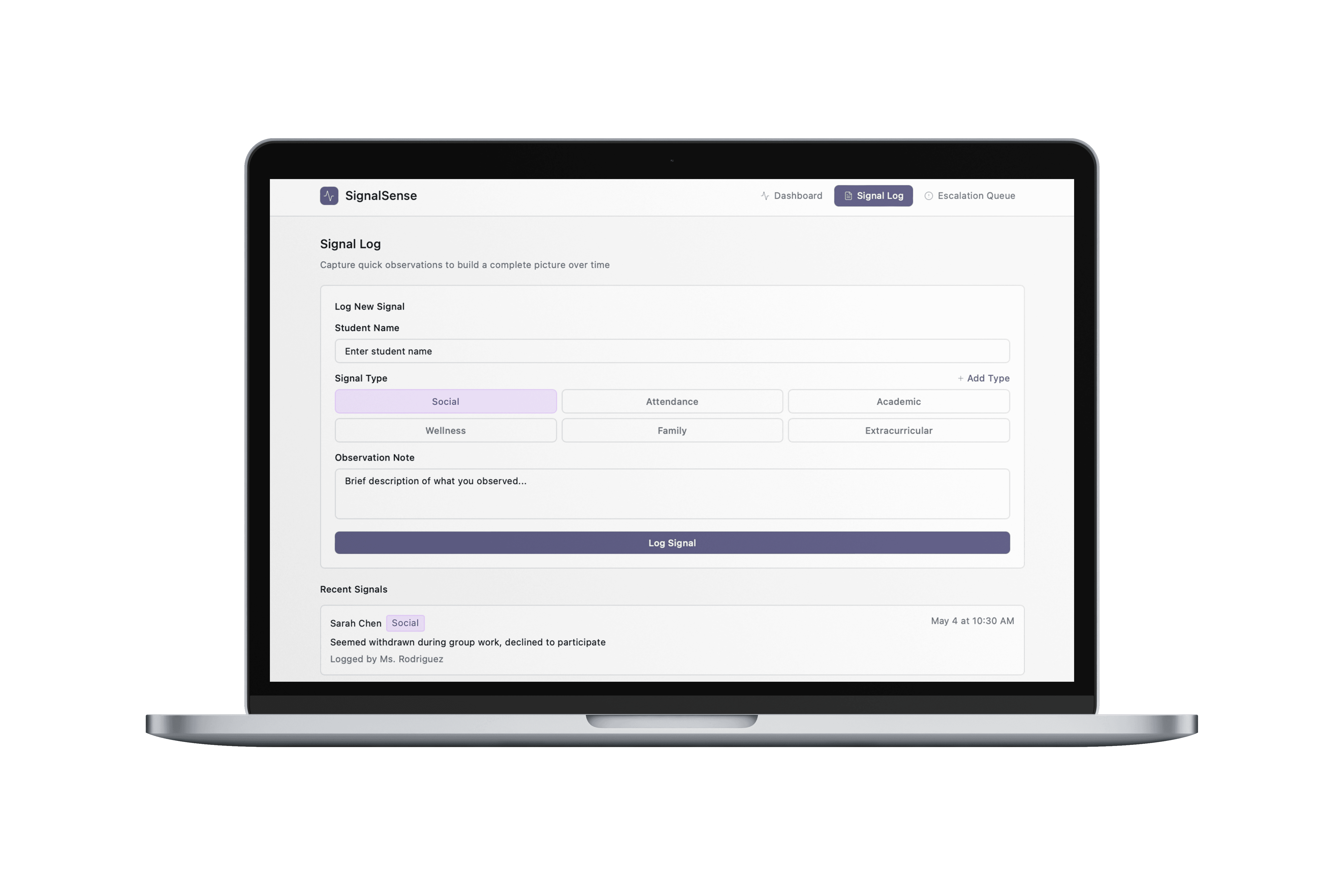
Student Documentation Hub
The documentation hub centralizes counselor notes, referrals, observations, and student interactions into
a single structured record. Information is captured consistently while preserving the flexibility needed for
nuanced situations.
CAPTURE · 01
KEY DESIGN DECISION
The timeline emphasizes significant moments,
recurring events, and key transitions while
allowing deeper exploration when additional
context is needed.
KEY DESIGN TENSION
Counselors needed access to historical context
without being overwhelmed by excessive
information.
Context preservation
VALUES INTEGRATED
Reduced cognitive load
Traceability
Temporal understanding
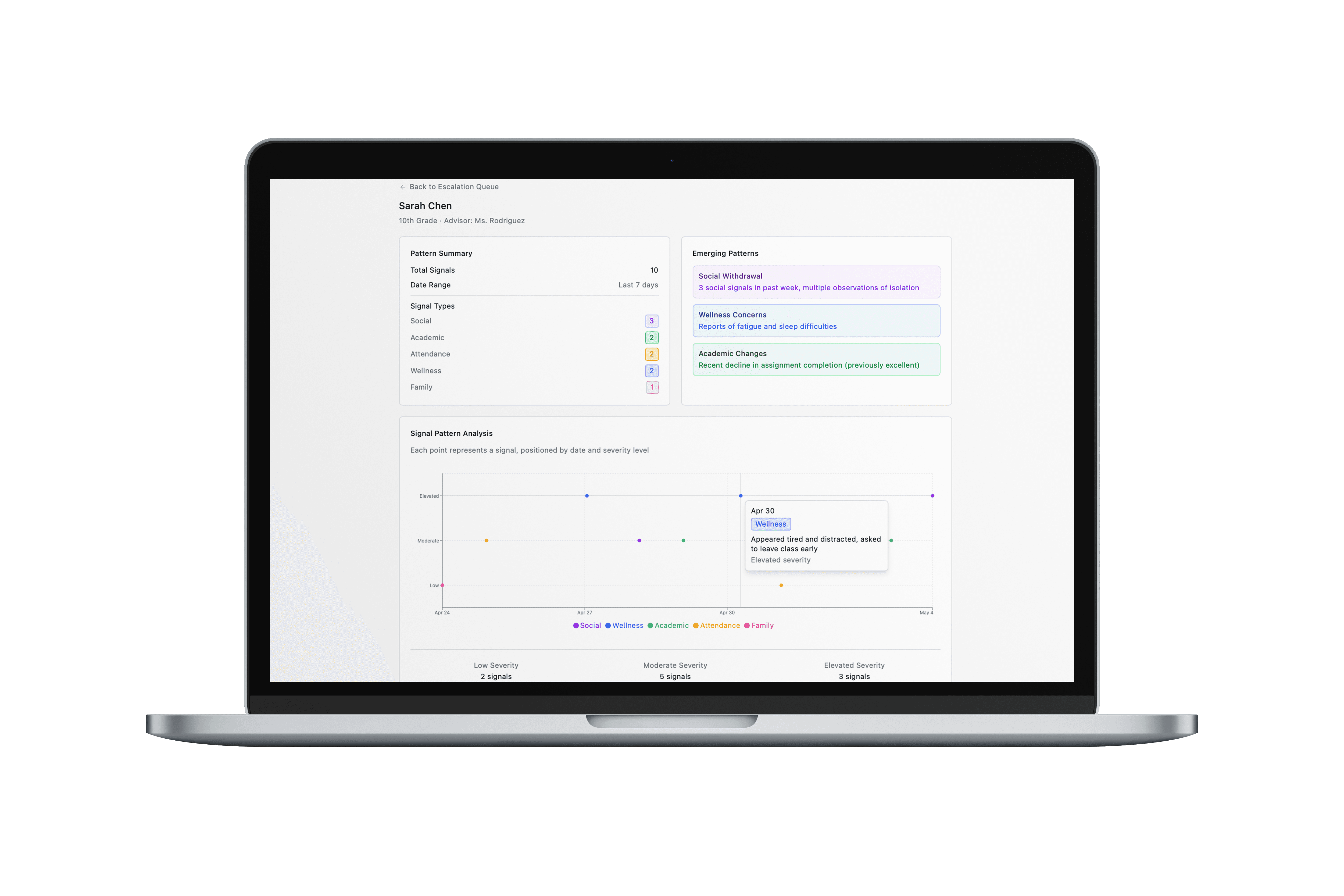
Student Journey Timeline
The timeline organizes student interactions chronologically, connecting documentation, interventions,
referrals, and outcomes into a coherent narrative.
SYNTHESIZE · 02
KEY DESIGN DECISION
Information is surfaced based on relevance
and context, ensuring counselors receive
meaningful support while remaining fully in
control of decision making.
KEY DESIGN TENSION
Insights needed to be visible and useful
without overwhelming counselors or creating
alert fatigue.
Actionable awareness
VALUES INTEGRATED
Human centered decision support
Trust
Timely intervention

Insight Layer
Brings relevant information, patterns, and contextual insights forward at the moment decisions are being
made, reducing the need for manual reconstruction and information gathering.
SURFACE · 03
Bringing It All Together
The final solution supports counselors throughout the sensemaking process. Information is captured
consistently, synthesized into meaningful context, and surfaced when it is most relevant, reducing the effort
required to reconstruct student history and enabling more informed interventions.
Expected Impact
By centralizing information
and surfacing relevant context,
counselors no longer need to
manually reconstruct student
histories across disconnected
records.
Reduce Cognitive
Load
Emerging concerns become
easier to identify through
synthesized insights and
longitudinal context, supporting
earlier intervention.
Improve Pattern
Recognition
Relevant information is surfaced
at the point of decision making,
allowing counselors to act with
greater confidence and
awareness.
Support More
Informed Decisions
Expected Impact
Designing for sensemaking, not information access
The challenge was not helping counselors find information. It was helping them connect
fragmented records into meaningful context. Designing for interpretation and understanding
proved more valuable than simply improving retrieval.
Research reshaped the problem space
Early assumptions focused on documentation and information management.Research revealed
that the deeper challenge was the effort required to reconstruct context, recognize patterns,
and make decisions across incomplete records.
AI should support judgment, not replace it
The most important design decisions were not about what the system could automate, but what
it should leave to counselors. Trust came from surfacing context and patterns while keeping
interpretation and decision making firmly human.
Systems matter more than individual features
No single feature solved the problem. The value emerged from the relationship between
capturing information, synthesizing context, and surfacing insights. Thinking in systems created
a more cohesive and impactful solution.